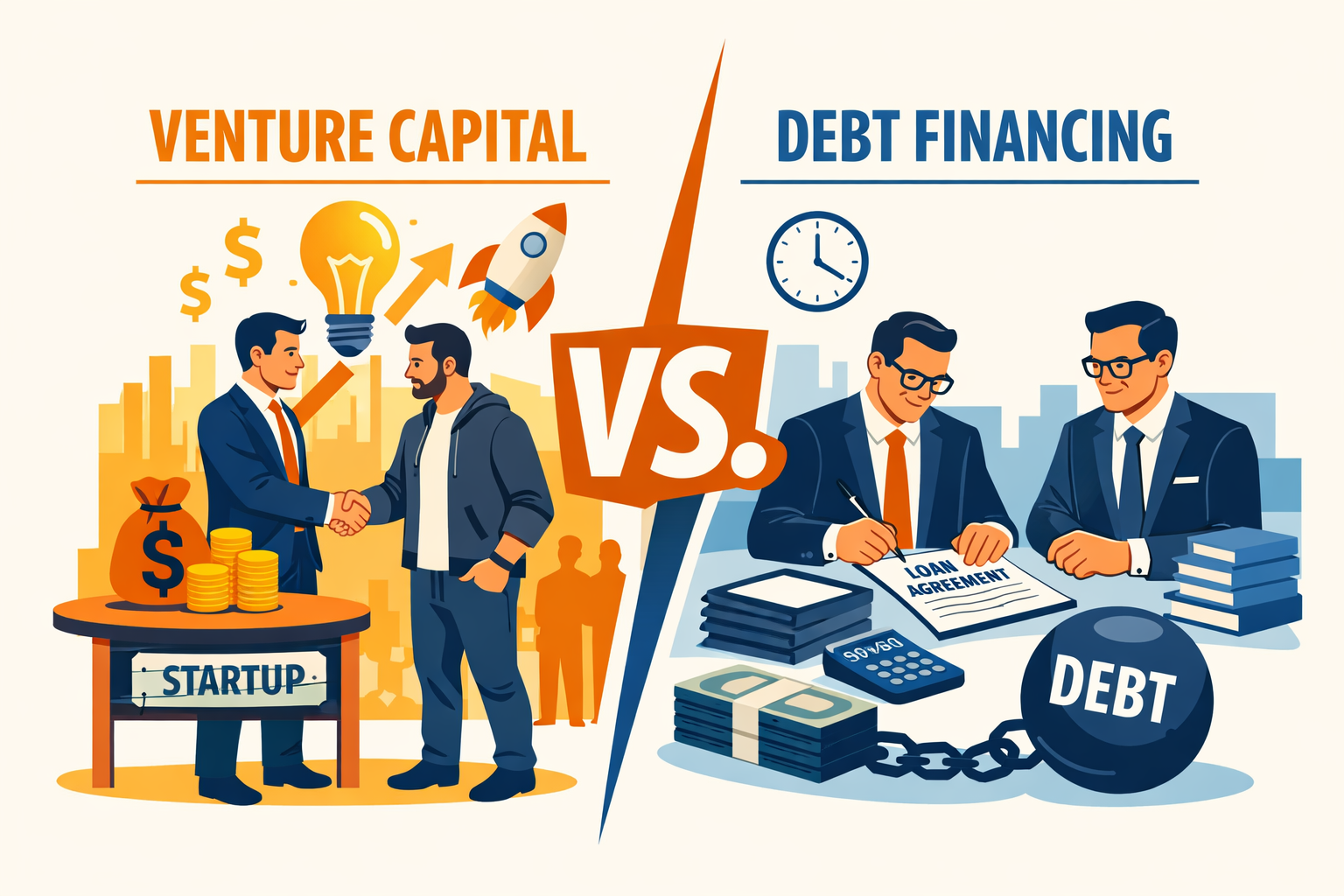
When a business reaches a pivotal growth point, the primary challenge often shifts from operational execution to capital acquisition. Choosing how to fund your expansion is one of the most significant strategic decisions a leadership team will make. The two primary pathways—Venture Capital (equity) and Debt Financing—each offer distinct advantages and trade-offs that can alter the trajectory of your company.
Here is a breakdown of how to evaluate these options for your next phase of growth.
Venture Capital: Fueling High-Octane Growth
Venture Capital (VC) involves selling a portion of your company’s equity in exchange for capital. This is typically the preferred route for companies in high-growth industries like tech or biotech, where rapid scaling is required.
-
The Pros:
-
No Monthly Repayments: Unlike a loan, equity investment doesn’t require monthly interest payments. This allows you to reinvest all available cash flow back into the business.
-
Strategic Partners: Beyond the cash, VCs often provide mentorship, industry connections, and board-level expertise.
-
Shared Risk: If the venture does not succeed, you are generally not personally liable to pay back the investment.
-
-
The Cons:
-
Loss of Control: You are giving up a seat at the table. Significant decisions may require investor approval.
-
Equity Dilution: You are trading away future value. If the company becomes a massive success, the “cost” of that early capital can be seen in the significant portion of the exit proceeds that go to the investors.
-
Debt Financing: Maintaining Ownership and Control
Debt financing involves borrowing money from a financial institution or private lender that must be paid back over time with interest. This is often the path for established companies with predictable cash flows.
-
The Pros:
-
Retain Full Ownership: The lender has no say in how you run your business, and they do not own any piece of your company. Once the loan is paid, the relationship ends.
-
Tax Benefits: In many jurisdictions, the interest payments on business loans are tax-deductible, reducing the overall cost of the capital.
-
Lower Long-Term Cost: For a highly profitable company, debt is almost always “cheaper” than equity because you aren’t sharing future profits with a partner.
-
-
The Cons:
-
Cash Flow Pressure: You must make payments regardless of your monthly revenue. This can be a strain during “lean” months.
-
Collateral and Personal Risk: Many debt arrangements require business assets or personal guarantees as collateral.
-
Qualification Hurdles: Lenders typically require a proven track record of revenue and a strong credit history, making it difficult for very early-stage startups.
-
Which is Right for You?
The choice often comes down to your growth speed and your exit strategy.
If your goal is to “blitzscale”—growing as fast as possible to capture a market—the heavy injection of Venture Capital is often necessary. The lack of debt servicing allows for aggressive hiring and R&D.
However, if you have a stable, profitable business model and you simply need capital to open a new location or purchase equipment, Debt Financing allows you to scale while keeping 100% of the rewards for yourself.
The Strategic Middle Ground: Many sophisticated firms utilize a “capital stack” that includes both. By balancing equity for long-term stability and debt for specific growth projects, you can optimize your cost of capital while maintaining the flexibility needed to dominate your industry.






+ There are no comments
Add yours